jueves, 1 de enero de 2015

Armageddon: A review of a bad movie

The man that saves the day,
the planet, the banks,
the everything...
I don't know why, but sometimes I get this internal need to watch a terrible movie. Last night I just crancked Armageddon into my player and enjoyed the high budget low thought plot of this 1998 hit.

This film grossed over $200 million and it was pretty successful, especially when compared to its competitor "Deep Impact", which was released around the same time and had a bit of a more complicated plot. Armageddon received mixed reviews, quite much as any summer blockbuster normally does, so there were no high expectations on thinking of this as a classic. The plot of the movie is that an asteroid "the size of Texas" is heading towards the Earth; seeking a solution to survive, NASA hires Harry Stamper (Bruce Willis) and his crew, to fly to space and drill a hole in the asteroid and place a nuclear bomb to make it explode. The side plot has A.J. (Ben Affleck) having a romance with Harry's daughter Grace (gorgeous Liv Tyler), which obviously Harry opposes. So now, let's rip this one apart! Where do I start?

Like another box-office hit released a year before (Titanic with Celine Dion), Armageddon features heavy use of a single band in its soundtrack. I love Aerosmith, but man... it's so not cool to use Aerosmith's talents in this piece of junk! Let me refocus so I don't take it on the music so much. Let's move on to the script.

I'm telling you. "I don't want to miss a thing" could have been used for TITANIC the previous year
and it would have had the same success at the Oscars!


There are so many flaws and crazy situations in this movie, I can imagine the producers having a ball and laughing at us viewers as they come up with the scenes for the film. The majority of them involve Ben Affleck. Allow me to explain:

  • Apparently, the President of the United States is an ignorant. One would hopefully think of him as a college graduate, with perhaps some sort of masters or PhD education, but that's not the case in Armageddon. He just cannot understand descriptions of physical dimensions of objects, like "Miles." So when addressing the president, it's better to simply tell him that the size of an asteroid is the same than just a random state. Imagine the dialog:

"What's the size of that asteroid?"
"Well it's the size of North Dakota Mr President.
"I don't quite follow, do you have another one?"
"Yes, it's the size of Wyoming"
"Ok cool!


  • So life in our planet has a few days left (unless the crew succeeds), and while there are several training exercises the new astronauts have to focus on such short notice, but hey!... there is always time for AJ to play with animal crackers on my Grace's tummy. 

AJ and Grace really know what's important in life
The world is in danger, but hey ...animal cracker fun?

  • By the way... what about quarantine? Aren't astronauts supposed to be on like 24-48 hours of quarantine prior flying out to space?
Yeah baby, we don't need quarantine, cause I miss you baby, and I don't want to miss a thing

  • Right after AJ is fired, apparently it took him just a couple of days to get his game together and start his own company "AJ Oil Drilling", which already has a functioning drilling platform and even features an "AJ for President" ad. That must be the quickest start-up business in the history of the oil industry!
  • The movie addresses well the advantages of being in a position of power in the business world. If you happen to be part of a team who is going to save a world, you can get a lot of stuff done for you: erase parking tickets, get the best suite of the Caesar's Palace, and not pay taxes!
  • It's a wonderful idea to leave a completely untrained, unprepared american ignorant astronaut in charge of monitoring the pressure valves of the fueling system in the Space Shuttle. It's funny how cosmonaut Andropov refers to his uncle as "the genius" of the family. In his case, the apple fell far away from the tree.
  • Not to far... this scene cracks me up every time: when the space station is about to blow, Harry asks "where is AJ", to which the Colonel answers "he's gone". Right then Harry says "I'm not leaving without AJ!!!" So what was his plan? To actually sit down in the space station and wait for AJ to come? To look for him? Was he willing to jeopardize the entire operation just to save AJ?
  • General Kimsey (played by Keith David) is such a character that gets so much hate. He's supposed to be the jerk of the movie, always slowing down or being an ass to whichever situation he's involved. "The President's adviser says... (insert random comment here)."; or ..."The President just told me secondary protocol";... "The President just told me to pull my pants down and do the hoopa loopa!" What's even funnier is that Keith David redeems himself in Requiem for a dream, where his character is jaw dropping awesome cool. 
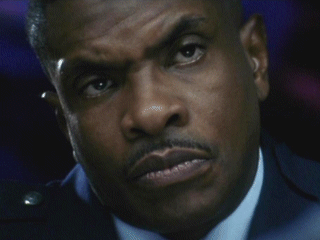
A force to be reckoned with: "I was't talking to YOU!"

  • Another one from Kimsey as he tries to convince the President of... but hey, the President orders him to override the system. By the way, those secondary protocol dudes really came in fast from the elevators. Where they just holding the STOP button and waiting for the order so they could open the door?
  • Wasted actors: the movie's budget is so high, one wonders if maybe it could have been lowered a bit ...and by a bit I mean A LOT. Man, so many charities out there to donate money. I'm particularly referring to the crew that fly in the Independence shuttle and especially Owen Wilson. I wonder how much money was he paid to be on this movie, because his character doesn't really do that much. I mean, he has lines but nothing he says is either relevant or helpful to the plot, well maybe with the exception of the "body hormones going in 1,000 different directions." I think there was another guy of Harry's crew who dies in that scene, but again he didn't do much. He was probably paid with Walmart coupons.
"Yeah man, hormons are flying in like 923924240 different directions! In this shuttle!"
How was THAT helpful to the plot?  Oh and he's bright but distracted.

  • Oh by the way, when AJ finds Oscar's body, he has to yell just to make sure he is dead. 
  • Grace (Liv Tyler) has nowhere else to go. This has to be crystal clear to everyone, especially for NASA's director of operations.
  • Here's another Ben Affleck one (boy they really gave him a chance to go for it on this one). When AJ is driving the Armadillo/driller car on the asteroid, Andropov asks him "do you know what are you doing?" to which AJ replies "No! This button right there, I don't know what it does!" So wait a minute: aren't you driving the armadillo/drill car you're supposed to know how to work it? How come you don't know what those buttons do? And assuming the vehicle was made for astronauts, then why is he driving it then? Why not let Andropov drive it?
This thing is awesome. It has a loaded machine gun, it drill through asteroids...

  • I can't seem to find a scene where this is explained, but why does the driller have a machine gun loaded on it? Well, maybe it was needed so that AJ could say his "that's how we do things from where I come from" line.
  • Everytime AJ has a "hunch" something bad happens. It pays off the one time he was actually right, was the one that really mattered!


  • and of course "What are you doing with a gun in space!?"
Let me remind you that this asteroid has no laws against me shooting you


Oh well, I had so much fun writing this I hope you had as much as I did. Next time you catch Armageddon, try to see if you can discover something else I overlooked.

A song for each purpose

I was browsing through some of the people I follow on Twitter and I came across this user who had posted a blog that read "A romantic song", "A fun song", so it gave me the idea to compile my own list which I want to share, so here we go... I hope you enjoy it:

A song that rocks: 21st Century Schizoid Man - King Crimson http://www.youtube.com/watch?v=zBfCzhYbWBk

A romantic song: That's the way of the world - Earth,Wind and Fire http://www.youtube.com/watch?v=jsAaLNMtb1A

A day in the beach song: Sunshine reggae - Laid Back http://www.youtube.com/watch?v=oMW5m7Kx6rE

A gosu song: Come Together - The Beatles http://www.youtube.com/watch?v=N8LZGQ4MkvQ

An inspiring song: Don't stop believing - Journey https://www.youtube.com/watch?v=PBEXSiFzOfU

A song to slash your wrists: Symphony #6 Finale - P. Tchaikovsky http://www.youtube.com/watch?v=BGIL_yyT3wI

A beautiful song: My Love - Paul McCartney http://www.youtube.com/watch?v=0SB3x6KtNi4

A fun song: Girls just wanna have fun - Cyndi Lauper http://www.youtube.com/watch?v=PIb6AZdTr-A

A true song: Man in the Mirror - Michael Jackson http://www.youtube.com/watch?v=PivWY9wn5ps

An goth song: How soon is now - The Smiths http://www.youtube.com/watch?v=HUMh8GQnDW8

A danceable song: Le Freak - Chic http://www.youtube.com/watch?v=5TBublGERS4

A hippie song: California Dreaming - The Mamas and the Papas http://www.youtube.com/watch?v=dN3GbF9Bx6E

An overplayed: We are the champions - Queen http://www.youtube.com/watch?v=04854XqcfCY

A porn song: Je t'aime moi non plus - Serge Gainsburg http://www.youtube.com/watch?v=k3Fa4lOQfbA

An honest song: You've got a friend - Carole King http://www.youtube.com/watch?v=trEwDejTKRY

A disco song: Stayin' alive - The Bee Gees http://www.youtube.com/watch?v=_Vj092UgKwQ

A song to dedicate: Lost in your eyes - Debbie Gibson https://www.youtube.com/watch?v=8Ms3mJFkSeg

A guilty pleasure song: Dancing queen - ABBA http://www.youtube.com/watch?v=xFrGuyw1V8s

A special song: Imagine - John Lennon http://www.youtube.com/watch?v=yRhq-yO1KN8

A talkative song: A walk on the wild side - Lou Reed http://www.youtube.com/watch?v=WZ88oTITMoM

A song that will never be forgotten: Rock around the clock - Bill Haley http://www.youtube.com/watch?v=O21xFX7QBpE

A depressing song: I'm not in love - 10 cc http://www.youtube.com/watch?v=2rgepWg4rzw

A childish song: Twinkle twinkle little star - Mozart's variations http://www.youtube.com/watch?v=im_tJLeo2qU

A relaxing song: Summer Madness - Kool and The Gang http://www.youtube.com/watch?v=5bfzWj5a_Y4

A terrible song: Friday - Rebecca Black http://www.youtube.com/watch?v=kfVsfOSbJY0

A song that goes straight to the point: Kiss and say goodbye - Manhattan http://www.youtube.com/watch?v=sARlnKk23xw

A unique song: A day in the life - The Beatles http://www.youtube.com/watch?v=P-Q9D4dcYng

A different song: Lizard - King Crimson http://www.youtube.com/watch?v=chBpJ-IfA7Q

An important song: Ode to joy - Ludwig van Beethoven http://www.youtube.com/watch?v=paH0V6JLxSI

A robust song: Stairway to Heaven - Led Zeppelin http://www.youtube.com/watch?v=0niLOyhCd5g

A rap song: Stan - Eminem https://www.youtube.com/watch?v=jqi-38YRkVg

A sensual song: Stay a while - The Bells http://www.youtube.com/watch?v=SAroPEI7Y30

A cool song: Tub Thumping - Chumbawamba http://www.youtube.com/watch?v=LODkVkpaVQA

An erotic song: Nikita - Ralph Myerz http://www.youtube.com/watch?v=N77lLFF7CAI

A song to listen all by yourself: Baker's street - Gerry Raferty https://www.youtube.com/watch?v=lSIw09oqsYo

A progressive song: Time - Alan Parsons https://www.youtube.com/watch?v=8mJDqLatGLk

A sad song: Mozart's Requiem https://www.youtube.com/watch?v=sPlhKP0nZII

A feminine song: Quelqu'un m'a dit - Carla Bruni http://www.youtube.com/watch?v=XvyMG0z0FZY

A dark song: Black Sabbath - Black Sabbath http://www.youtube.com/watch?v=akt3awj_Ah8

A song all women like: Words - FR David http://www.youtube.com/watch?v=meV0b1Wv4-o

A perfect song: Papa was a rollin' stone - Temptations http://www.youtube.com/watch?v=R6c0P5sWCWg

An instrumental song: Love theme - Barry White http://www.youtube.com/watch?v=hBgKBJVm1p0

A song that cheers your day up: Starting over - John Lennon http://www.youtube.com/watch?v=utc09QGs-3c

A song that says it all Smells like teen spirit - Nirvana http://www.youtube.com/watch?v=hTWKbfoikeg

A story telling song: Space Oddity - David Bowie http://www.youtube.com/watch?v=D67kmFzSh_o

X Men First Class

I can't lie when I say I was a bit hesitant of watching X-Men First Class. As it happened before with the transition between Batman & Robin and Batman Begins, I too had believed the franchise was headed to the bottom of the ocean, after X-Men 3: The Final Stand.

So I started to watch the movie with very low expectations and began to see that like Nolan's Begins, this was another resurrection. While some elements of the plot divert from the original comics, it doesn't mean that they are sloppy or weak. Contrary to Batman Begins, where Nolan decided to strongly stick to the comics, in First Class we see a few unexpected events that hardly and X-Men fan would imagine.

The performances however are solid, especially Michael Fassbender's Eric Leshner aka Magneto. To quote an internet user from a public forum, "it's very hard to think of Magneto as a bad guy, yet alone hate him after seeing X-Men First Class." The main plot of the movie touches how Eric and Charles Xavior aka Professor X live their young lives as mutants until by casual circumstances, end up meeting and sharing interests. It also touches on the internal identity conflict that other mutants face when confronted by humans, focusing primarly in Raven aka Mystique and Hank McCoy aka Beast.

The main villain is played by superbly by Kevin Bacon, who in a strange combination looks menacing and charming at the same time. Other members of the cast include January Jones, Rose Byrne and Oliver Platt. There are some rushed scenes and unexplained situations that give away an otherwise great film and I would like to name a few of them:

1) The real pain killer is: Why the need of all the "join me" / "decide" / "pick now" questions? More importantly: these guys don't give a lot of time for one to decide, and the characters also don't go over thinking it either. When Sebastian Shaw attacks the CIA he's like "join me or whatever". So I'm like: Well, did you really have to create all this fuzz and attack and kill all those agents for that? A simple phone call would have settled it!

Then in the end, Magneto asks the same question: "join me or whatever, decide"... and everyone is like "well let's stay with Charles" while others go with Eric. But they don't even think about it or at least discuss it! I mean, shouldn't they list pros/cons of joining either side?

2) I really liked Jennifer Lawrence's performance and her character. The one thing that bothered me was how all of the sudden she's jealous on Charles, hitting on Hank, then on Eric, and then on Charles. Like, settle down woman...I know your hormones are crazy, but take it easy!

3) I like how they portrayed the military officers, as closed as they can be, both Russians and Americans. However the cliche line "gentlemen, it's been an honor to serve with you" was way over the top!

4) Gambit missing or the delicate topic. I have to state, Gambit is not my favorite mutant by any means, but seriously we have been through four X-Men movies and STILL NO GAMBIT? I was honestly expecting to see at least a cameo.

5) I think the ending was almost perfect, but something was left unexplained: How did they get out of the beach? What did the Russian and American fleet do after they were almost wiped out entirely? It would have been cool to see an explanation.

6) and... why did Magneto rescue Emma Frost? She almost killed him and he goes back for her? I didn't get that trade.

Apart from these little details, X-Men First Class is a great movie and I call it a success in the revamp of the franchise. I want to see some new equally good stuff soon, and hopefully my favorite mutant finally appearing on screen: Franklin Richards

The Avengers great predecessors

I've been hearing a lot of good reviews about The Avengers -Marvel's latest development in the comic movie genre, that combines the most important superheroes of the Marvel Universe. Staying true to myself of letting a bit of the hype pass by, I'm going to wait for a few more days to go and watch it. So for now, I'm going to talk about great comic movies from the past.

Characters from Marvel _Universe reunite for the first time

Let's face the facts: for the best of times, producing a comic/superhero/hero movie was seen as a gamble formula to create a popcorn movie that would be forgotten two years after its release. Only recently it has become a substantial investment that not only brings a great box office number but also great reviews and Oscar nominations.

To be fair and honest, in my mind there are three guys who deserve credit for making this happen: Tim Burton, Michael Keaton and Jack Nicholson. The year was 1989 and the movie was Batman, set in a very goth-a-like Gotham City, featuring a novelty crazy clown Joker played by Jack, a superb Batman/Bruce Wayne portrayed by Keaton, and the great direction of Tim Burton. This was a movie that was dark, interesting, funny at times, but more than anything, it brought a story about a superhero who struggled with his emotions and was seen as a human who fight his way against crime.

A troubled Bruce Wayne, by Michael Keaton

Up until that point I would say that comic movies were close to utopic environments. Either the main character was "too nice", or the plot was "predictable", or the movie couldn't be taken seriously because of any detail that separated it from other films. Examples of this can be mentioned in Batman (1966) starring Adam West and Superman (1978) starring the late Christopher Reeve.


Superman and Louis in the 1978 classic


"Hand me the Bat-anti-repellent shark spray!"
Batman (1966) was an extension of the TV Series that was a major hit in the 60s. The movie isn't bad per se; in fact, it's a series of absurd situations that add up for a hillarious result. In one particular scene that shocks me every time I watch it, Batman is hanging on a ladder from the Bat-Chopper being bit by a shark, so he asks Robin to hand him the "Anti-Shark Repellent Spray." Superman on the other hand was a decent approach to produce a serious effort in a film. However there was still an idillic feeling you could get betwen Superman and Louis Lane, like nothing could get wrong between them. After all, she's with Superman.

Coincidentally, Batman opened the door for another comic movie to set new standards on the genre and even become a classic. In 2005 Chris Nolan ventured to direct Batman Begins, a film that tells the story of how Bruce Wayne became what he was destined to be, that is, Batman. Putting a hand on your heart, one should acknowledge that Batman Begins and Nolan's effort is better than Burton's. While Christian Bale is able to hold his own against Keaton's interpretation of the caped hero, the rest of the cast from Begins is superior than the one in the 1989 film. The script is also sharper.

Nolan's revival of Batman Begins brought incursion of most key characters from the comic books.
It also built the story more based on the comic books stories.

A handful of successful films both box-office wise and critic wise had preceded the nature of Nolan's vision, such as the X-Men franchise which was handled by Bryan Singer -another respected name when it comes to directing-. And just like that, another series of films followed suit diving deeper into the comic world, like Spiderman, Hulk, Superman Returns, the Fantastic Four, among others. Robert Downey Jr teamed up with Jon Favreau to power up the Iron man, in a cast filled with Oscar winners like Gwyneth Paltrow, Terrance Howard -eventually replaced by Don Cheadle in the sequel-. As Iron Man became another success for the comic world, Nolan stroke gold again in The Dark Knight -his sequel of Batman Begins-, adding up a memorable performance of Heath Ledger portraying the manic sociopath Joker villain. Equally impressive as its predecessor, the only flaw I find in TDK is the fact when watched in perspective and seen objectively, things seemed a bit rushed in the plot of the movie. It kind of lacks the smooth pace that Begins had, where every event has a reason and we get to see the why of that reason. Anyway, let's get back on topic.

Finally, the last couple of years saw the emergence of the character build up for what today we have been presented as The Avengers. To be fair honest, today, May 8th of 2012, I believe so far Batman Begins is the best comic movie, followed closely by The Dark Knight. In a few days I will watch The Avengers three or four times -like I always do when analyzing a movie- and I will likely blog a comparison between it and its great predecessors.

The Avengers' Cast

Man on wire

Man on wire

Last night I had the privilege of watching one of those films that are truly inspiring. I hadn't watched many movies recently, so I decided I had to pick it up with something worth it. I stared at my DVD collection and the title "Man on wire" caught my attention.

As usual, I play the movie without knowing anything about it other than it is rated highly on my sources notes and that if it's in my movie collection, it's because... this is probably a great film. Well, it happens it's not really a movie... it's a documental. That much I will spoil about it.

Man on wire is a very fascinating exploration into the human mind and the inner feelings of finding a dream, pursuing it, following your gut, being inspired and free the human spirit as almost no other film can do it. From a cinematic point of view, the direction, the music, the editing, are nothing short of superb. From a human point of view, it's something new that you don't see every day.

Something that I have found interesting about us humans as a society is that we place so much interest and admiration to imaginary heroes, like Luke Skywalker, Batman, Godzilla, but when it comes to real life heroes our interest isn't really that high -or at least, as it should be-. This is something I first experimented when I watched Lawrence of Arabia and discussed it over an online boards with a few users, and one of them was complaining how "weak and gay" Lawrence looked like. This was met with a great reply by another member who said "that's the way how real life heroes are, they are human, with defects and weaknesses. They become heroes because they're strengths are more significant." We don't know much about Lawrence of Arabia because he was a short, plain, normal guy, just chasing an extraordinary dream, just like Phillipe Petit did in Man on wire.

Another great aspect from Man on wire is the clear establishment of leadership and management. You can differentiate who is the leaders and who are the followers, and how decided the leader is in conquering his goal regardless of the obstacles that appear on the road. You can also see what it feels to be supported and backed up, sometimes by friends and other times by total strangers, who may or may not agree with you at times, but share the common interest of reaching the goal and feeling part of a group of people that achieved something.

There is another little spoiler I will give about Man on wire and it's the second star of the film: The WTC Twin Towers. Today they only exist in the memories of those who saw them, but in the film they are as vivid and powerful and imposing as they were during their almost 30 years of existence. Apart from appreciating the entire journey of Phillipe Petit and his friends, you also come to appreciate the objective the Twin Towers had when they were built and how big their influence was in the lives of many people around the planet. It's mind blowing how a couple of buildings can have such dramatic impact, even before they even existed. I guess that's the small sentimental part that makes Man on wire a very human film: to understand that what Petit did, will not be done ever again.

Lilya 4-ever: A must see

or over five years, I have been subscribed to a very good movie forum, where most of the members are hardcore movie addicts in terms of quality and artistic point of view that the film expression brings to us viewers. Every now and then one of the members posts a recommendation of a film that rarely makes it to Hollywood (or America for that matter), yet it is right there with any Oscar or Golden Globe nominee or even winner, despite being labeled as "independent" or "foreign", or whatever; today's recommendation was Lilya 4-ever.

One of the greatest (if not the best) movies of 2002

The thing is that I have already seen Lilya 4-ever, because another member had sent me word about it somewhere around early 2009. I remember it vividly because I had just moved to a new house and I didn't have a TV yet, so I downloaded and watched the movie in my PC back then. For those of you who haven't, I'm going to try to share a bit of insight about this terrific film, hopefully without spoiling too much about it. Every time I get a recommendation, I normally do a little research on it and read (make that scan, or skim) reviewer's opinion, trying to avoid as much as I can from the plot or any potential spoiler. That time, this wasn't an exception.

The first thing I noticed when I researched information from the movie is that there is no tagline for Lilya 4-ever and now that I think about it, I don't think there is a human being capable of coming up with one, but I'll discuss more in deep later. I remember then being puzzled about the "4-ever" wording in the title of the movie. As I noticed the director was Lukas Moodysson, I immediatly identified him as the man behind another film I have in my collection and I hadn't (and still haven't) watched yet, "Fucking Amal" -named "Show me love" in the US-. I had heard good things about "Fucking Amal" but hadn't had the chance to verify it with my own eyes. Somehow Lilya 4-ever looked a bit more interesting to me, and since I have no real algorythm to decide which film I watch first, I simply proceeded to go with Lilya and find out what was the deal about the "4-ever". The few websites that I track and get rating from (like IMDB) had a very high score for this film, so basically everything was there enticing me. Play it is!

Lilya and her best friend Volodya

IMDB summarizes Lilya 4-ever's plot like this:

"Lilja is 16 years old. Her only friend is the young boy Volodja. They live in Estonia, fantasizing about a better life. One day, Lilja falls in love with Andrej. He is going to Sweden, and invites Lilja to come along and start a new life."

I have no idea who posted that summary, but I do know this: I would really like to congratulate that person, because it is amazing how he or she was able to come up with this brief paragraph without giving any clue of the series of events that occur in this film, their cause, consequence, or justification. Honestly it's one of the best descriptions I have read that is able to cause that engaging effect to drag you and watch this enigmatic film. 

Lilya 4-ever is loosely based on a true story, but it doesn't have to be. The amazing thing about Lilya 4-ever is that it's not like these "based on a true story" films that you watch and you go like "oh well, sure that happened... that's nothing new, or nothing anyone shouldn't know", like say "The Pianist" or even "Schindler's list". I mean yes, the holocaust and everything was terrible, but it's not something that you shouldn't be unfamiliar with, especially if you have access to any decent contemporary history book in your local or home library, considering that WWII was such an extraordinary event. At the same time, it's an European/Independent film, meaning yes it is crude, inventive, original and to the core, but it's not like "Die Blechtrommel" or "Karakter", that have to go through a bit of imaginative tactics to get their plus score, despite their plots being family oriented.

Family and Friendship

Lilya 4-ever is the kind of film that opens your eyes and awakens the inner side of you that is sleeping and nor appreciating life in its entirely, taking for granted benefits like good health, the ability to eat three meals of good food every day, and even good sleep. Have you ever watched how series like "Southpark", "It's always sunny in Philadelphia" make satiric comments about the world outside America, notably in 3rd world countries? Well, Lilya 4-ever is the perfect movie to show you the reality of how is life in a 3rd world country; a country with no life, no hope, no dreams and basically no reason to wake up every day for. It's is a crude movie that makes you wonder about subjective aspects of our society like morals, fairness, justice and what do we deserve as human beings when we arrive to this world and grow to become a part of it.

I consider myself very cold blooded and straight forward, but there has never been other film that has made me question my values and principle, like Lilya 4-ever did. You see, there is a difference when you watch Romeo and Julliet and feel sad because the main characters die in the end (oops, I hope I didn't spoil that... well if you didn't know that by the 21st Century, you should see a doctor), because you know that idilic as the love is between them, it is a play in the end, and that sense of fantasy is what blocks any further empathy you may feel towards either Romeo or Julliet. Lilya 4-ever's plot is the one that can happen every day to anyone... literally ANY of the characters involved in the movie, at any time in the current world set under the conditions the movie presents. Put simply, it is a movie where the good guy doesn't win; and it's not like the bad guy wins either, because that's the worse part. The bad guy doesn't even care of winning or losing. That's why I mention that there is such a strong statement of moral questioning.

One of many powerful scenes in Lilya 4-ever

The other strong element Lilya 4-ever has is how it tests your endurance and your stamina. At 1 hour and 49 minutes, it's not a long movie at all and it doesn't feel long at any time. The thing is that every scene has a lot of weight, and I mean A LOT. And I'm not sure if it's me or the movie, but it seemed like the weight in every new scene kept increasing. If you watch this film, you will feel your receiving endless uppercuts combinations thrown by Mike Tyson. There are two scenes that literally left me breathless -hopefully you can take not of them and share your experience-:

1. The second time Lilya goes to the grocery store

2. When Lilya's date says "just.... touch my hand"

It's always hard to say goodbye to your boyfriend/girlfriend at the airport
The minute you walk away you begin missing him/her and want to see him/her again

The beautiful part of Lilya 4-ever is that it makes you love your life. It LITERALLY makes you fall in love with your life. It also makes you wonder who or why are the Academy Awards and other film ceremonies are so oriented on overlooking brilliant pieces of art such as this. From Southpark's "Get Sexual Harrasment Panda", or "Petey the don't hold on to a large magnet while close a nearby giant metallic fan", Lilya 4-ever is a film that should be shown in schools to teach teens about the real world and why do we have to make our planet a better place. Remember: always worry about the real problems.

jueves, 29 de mayo de 2014

10 Factores Esenciales para lograr una Negociación Exitosa

A lo largo de mi experiencia profesional he estado relacionado en diversas posiciones vinculadas con las responsabilidades conocidas en el mundo como negociaciones, entendiéndose por negociación como un diálogo entre dos (o más) personas o partes con la finalidad de alcanzar un mutuo acuerdo, resolver diferencias, obtener algún beneficio o satisfacer intereses.

En este sentido he alcanzado logros importantes derivados de la necesidad de confrontar resultados inesperados, atender conflictos y conseguir logros inimaginables, así como tener que lidiar con resultados fallidos. En cada uno de estos casos, mi propósito final siempre es recopilar las enseñanzas y experiencias, y usarlas para mejorar mis competencias como negociador y conseguir satisfacer a mis clientes y por supuesto mi empleador. A veces hay dinero de por medio, o contratos, o deudas, especies, o cualquier variable que es perseguida por ambas partes.

No es fácil cerrar una negociación. Sin embargo, he aprendido que se vuelve fácil siempre que ciertos factores sean tomados en cuenta y ejecutados metódicamente. Hay distintos grados y maneras de enfocarlos. En esencia, del cuidadoso análisis que se haga de cada uno, depende el que se pueda complicar o facilitar una negociación.

Empecemos:

1. Documentarse

Es sorprendente la cantidad de negociaciones a las cuales he asistido, en donde alguno de los asistentes no está documentado sobre el caso, y no menos sorprendente es el porcentaje de negociaciones exitosas que he cerrado por estar mejor informado que mi contra-parte.

Un caso típico en el mundo de los negocios está compuesto por cuatro factores:

Administración
Operación
Temas Legales
Ventas/Mercadeo

El negociador debe documentarse de cada uno de ellos, puesto que existe la posibilidad que uno sea capaz de ofrecerme una ventaja competitiva. Recopilar la mayor cantidad de información y filtrar aquella de mayor utilidad, es el primer paso a seguir de un buen negociador. Por ejemplo: Si yo soy una empresa prestadora de servicios, y mi cliente está buscando zafarse de alguna cláusula lega, pero sé que el servicio ha sido prestado, y el cliente tiene atrasos con los pagos, es allí donde está mi ventaja. Debo ser capaz de identificar la(s) debilidad(es) del cliente, y explotarla al máximo. Posiblemente él hará lo mismo conmigo, y es allí en donde está la diferencia clave: ganará la batalla, el que mejor preparado esté.

2. Dar y mostrar respeto. Definir territorios.

Hace algún tiempo atendí un caso bastante complejo y delicado: en varias ocasiones me reuní con un cliente que tenía no una, sino dos demandas contra mi empleador -una importante trasnacional-. En papel, el cliente tenía todas las de ganar, y mi misión era convencerlo de retirar la demanda y lograr un acuerdo satisfactorio entre las partes. Por referencias de mis colegas, el cliente era muy difícil de personalidad y se le hacía muy difícil evitar llevar la negociación al plano personal.

En este caso lo importante es definir el territorio por medio del respeto. Lo primero es un fuerte y seguro estrechón de manos: que él reciba el mensaje y entienda que 1) podrá haber diferencias entre las partes, pero ante todo debe preceder el respeto mútuo, y 2) los representantes de las partes velan por los intereses de entidades separadas. Esto no es una guerra, pero se debe tratar con el protocolo estratégico de una guerra.

Luego de haber mediado, de poner malas caras, de que algunas amenazas salieran a flote, siempre al terminar sea respetuoso y estreche la mano de su contra-parte. Esto envía el mensaje y deja la puerta abierta a que el interés en buscar un fin común sigue abierto de su parte.

3. Romper el hielo

Esto tal vez suene cliché y más relacionado hacia la parte personal que profesional, pero he observado que tiene un peso significativo que puede hacer la diferencia en una negociación. Salvo en muy contadas excepciones (principalmente restricciones de tiempo o por la gravedad del caso a tratar), nunca se debe llegar a una negociación e ir directamente al grano.

Dependiendo del caso, hay ocasiones donde los stakes son altos. Existe cierta tensión, expectativa y hasta a veces nerviosismo en el ambiente. Puede haber una importante cuenta o un gran contrato en juego. Lo importante es dar a entender que fuera del punto que se está discutiendo, somos dos (o más) personas que podemos tener intereses comunes, y que fuera del negocio hasta pudiéramos tener alguna actividad para compartir.

Yo juego tennis y este punto lo comparo mucho, al calentamiento previo cuando se va a iniciar un partido de competencia: no busco pegarle fuerte a la pelota, sino pegarle con suavidad y consistencia, e incluso trato de leer la etiqueta de la pelota. Es un ritual de relajación que precede el momento de la verdad (el partido). En una negociación, sugiero tomar cinco minutos para charlar informalmente sobre temas en donde haya informalidad y se pueda relajar el ambiente.

4. Planificarse de forma organizada, diferenciada y manejable

No se puede llegar a una reunión sin planificación alguna, ni un orden estricto de los puntos a tocar.

Supongamos que tenemos a un cliente interesado en negociar temas legales, administrativos y operativos. ¿Por cuál empiezo y cómo lo trato? Comúnmente pasa que los negociadores "mezclan" los temas. Por ejemplo: "yo no te pago, si me garantizas operatividad". Caer en este juego es un error, dado que muestra que la persona está carente de argumentos y está buscando bases de dónde apoyarse cuando no las tiene. La postura correcta es: "tú me debes pagar. Indistintamente de que pueda o no garantizar operatividad, la realidad es que tú me debes pagar". Por consiguiente, hay que separar las churras de las merinas, y atender cada punto a tratar por separado.

Por supuesto, existen formas de evitar esta situación: es recomendable atender el punto en el cual mejor posibilidad de conseguir un acuerdo haya. Las negociaciones que empiezan bien, probablemente terminarán bien, y es un buen primer paso el tener algo positivo entre ambas partes. En este caso, si hay un compromiso de parte de la empresa, la actitud correcta debe ser primero "yo te garantizo operatividad, y te daré operatividad". Luego, se pasa al plano administrativo.

5. Mantenerse enfocado y leer rápidamente cada situación

Existen diversas publicaciones y referencias que estudian el lenguaje corporal de las personas. Por fortuna, he podido toparme con varias y ver en la realidad que muchas de las teorías son en efecto válidas.

Desde el momento que el cronómetro de la negociación empieza a contar, el foco debe estar plenamente en todo cuánto rodea al ambiente y los involucrados. Los tres principales puntos a observar están:

  • Ojos: son el primer reflejo que el ser humano tiene ante una situación dada. Haga contacto visual en todo momento, en especial al hablar con afirmaciones. Evite parpadear o desviar la mirada en puntos álgidos.
  • Cabeza: inconscientemente, girar un poco a la izquierda o a la derecha, asentar o acomodarse, son evidencia de aceptación, enojo, distracción o acuerdo. Mantenga su postura firme, pero no tensa.
  • Tono de voz y expresión: similar al anterior. Con la voz se determina el grado de formalidad que lleva la conversación, y el qué tan bien (o mal) van las cosas. No alce la voz, pero emplee un tono que imponga.

Hay que considerar, que estos puntos pueden trabajar separados o en conjunto (siendo éste preferible).

6. Exprese sus ideas con coherencia, lógica y si lo merita, rectifique sus planteamientos

Un día me encontraba en una clase de matemáticas financieras, cuando una compañera de clase me interrumpió para hacerme una pregunta: "¿De dónde sale el numero e?"

Al haber estudiado matemáticas en la universidad,  por mi cabeza pasaron un sin fin de maneras de explicarle el origen de la famosa constante. Pero había un detalle: ella es psicólogo. ¿Cómo le puedo explicar a un psicólogo el origen del número e, de tal forma que lo pueda comprender? Mi respuesta inicial fue escueta en el mejor de los escenarios: "es el número base del Logaritmo Natural". Su rostro de inmediato delató que no fue una buena explicación (note cómo hago uso del paso anterior #5 y pude leer la situación).

Al final de clase, le pedí se acercara y le respondí con una mejor coherencia y lógica: le expliqué que el origen del número e data del problema propuesto por Jakob Bernoulli del interés compuesto de una cuenta bancaria. Justifiqué el razonamiento y continué con otros aspectos, cómo la identidad de Euler, la convergencia de series, y luego la explicación del porqué es la base del Logaritmo Natural. Su lenguaje corporal denotó mayor satisfacción y en esta ocasión sí pude ver que ella entendió perfectamente lo que dije.

A pesar que no fue una negociación per sè, lo importante a destacar es que reconocí rápidamente que había cometido un error, dando una explicación insuficiente o etérea, y rectifiqué para poder lograr el objetivo.

En las negociaciones con clientes suele pasar mucho, el dar ciertas cosas por sentado que el cliente las sabe o las entiende, cuando en realidad no es así. Por ello, explicar con coherencia y lógica hace ganar muchos puntos positivos, dado que es muestra de conocimiento del tema y capacidad de exponerlo, nivelarse y hacer empatía. Rectificar un error gana aún muchos puntos más. Por supuesto, procure mantenerlas a un mínimo: una rectificación está bien (un error lo comete cualquiera); dos, ya crea ruido negativo en el ambiente; más de tres, es signo inequívoco que no se está preparado en lo absoluto.

7. Actúe al sentir debilidad, escuche cuando sienta fortaleza

Los tiburones van por su presa cuando huelen sangre. Esto es muy similar en los negocios. Si todos los pasos anteriores se han cumplido verbatim, eventualmente llegará algún instante donde el cliente mostrará un signo de debilidad: ese es el momento de tomar la ofensiva e ir a por él. Muchas personas alegan que el hay clientes que "no tienen signo de debilidad", lo cual es falso. En toda negociación, alguien va a ganar algo y alguien va a perder algo, y para hacerlo el cliente, debe tener fortalezas pero también puntos débiles. Si no, no sería una negociación. Atención: lo mismo aplica para el negociador.

Hago especial énfasis en el actuar. Sucede a veces que el negociador se "congela" y no reacciona a tiempo, o cuando lo hace es ya muy tarde. Es por ello que nuevamente lo repetiré: si todos los pasos anteriores se han cumplido verbatim, se sabrá cuándo es el momento donde el cliente esta mostrando debilidad.

Cuando el cliente está en modo ofensivo, es decir, se siente fuerte, es mejor reagruparse y dejarlo hablar, expresarse y desahogarse. Mírelo cuando habla, y esté atento a cualquier perla que pueda soltar. Ha habido ocasiones en donde los clientes mismos por hablar de más, terminan mostrando un lado débil que me permite tomar la iniciativa. En general, escúchelo activamente y siga el mismo canal que él lleva.

8. Siempre tenga un As bajo la manga

Otro cliché, pero que nunca está de más recordarlo. Personalmente, prefiero decir "siempre tenga un As, una K, una Q y una J bajo la manga", en el sentido que hay partes que son preferible reservar para otro momento (no necesariamente en la misma reunión).

Lo que sí es cierto, es que se debe guardar el mejor As para el final: la jugada que no espera el cliente, el squeeze play que nunca vio venir, el gol olímpico que parecía imposible. Esto da fabulosos resultados cuando ya no hay más otra opción, y el cliente piensa que ha logrado su objetivo.

En una ocasión estando yo recién contratado la empresa, un cliente se encontraba sumamente molesto con el servicio que había prestado y con la gerencia anterior, al punto que quería cancelar la cuenta del todo y darla un competidor. Intenté por todas las vías posibles convencerlo que nos diera una última oportunidad, pero no quería aceptar, a pesar que él "tenía un buen presentimiento" sobre mi como nuevo gerente que atendía su cuenta. Finalmente tuve que sacar mi As: "Hagamos algo: entregue la mitad de la cuenta a la competencia, y déjeme la otra mitad. De esa forma competiré con ellos y le demostraré con resultados concretos las promesas que estoy haciendo". El cliente quedó en el sitio sorprendido. Ahora tendría un barómetro para medir y comparar su nuevo proveedor con nosotros. Aceptó de inmediato. Dos años después, recuperé la otra mitad y se volvió uno de mis mejores clientes.

9. Prometa sólo lo que puede cumplir

Si ha llegado a este caso, es porque ha podido "quebrar la espalda del cliente" y ha logrado aceptar que negocien satisfactoriamente. Sin embargo el trabajo está lejos de estar terminado. Hay acuerdos, compromisos, pautas, medidas que tomar, y la pregunta es: ¿pueden ser cumplidas?

A nadie le gusta ser decepcionado. Esto es un síndrome que yace intrínseco en nuestro ADN desde niños: a ningún chico le gusta que Santa Claus no le traiga el juguete que pidió, a pesar que recibió su carta; ningún adolescente disfruta que la chica de quien está enamorado lo rechace, a pesar que le sonreía y se sentaba a su lado en el autobús. Las falsas expectativas son prácticamente mortales en los negocios, y a ningún cliente le gusta que no le cumplan.

Es por ello que debe ser muy realista entre la situación actual, la situación deseada a la cual se quiere llegar, y los medios disponibles para poder pasar de la actual a la deseada. El cliente apreciará mucho más la sinceridad que las ilusiones.

10. Tenga confianza, actitud y seguridad

Una de las anécdotas más interesantes de la biografía de Steve Jobs, es cuando anunció la venta del primer ordenador Apple. ¿Cuántas computadoras había listas para poner a la venta al consumidor? CERO. Steve vendió un producto que ni siquiera estaba en fase producción. ¿Cómo lo hizo? Confianza, actitud y seguridad.

Steve convenció a los inversionistas, periodistas, competidores y al público asistente, que el computador Apple era el mejor invento del siglo, aún mejor que la carne en conserva. Este esquema de negocios lo repitió varias veces, incluso con el lanzamiento del iPhone en 2007.

La confianza es la capacidad de creer en las habilidades que tenemos.
La actitud es cómo transmitimos es confianza.
La seguridad es el indicador de certeza de nuestra actitud.

En resumen, al seguir estos pasos:

Tenga la confianza que usted podrá negociar exitosamente

Demuestre en su actitud lo que ha aprendido.

...y siéntase seguro que puede lograr todo lo que se proponga.


Lic. Héctor Ruiz